
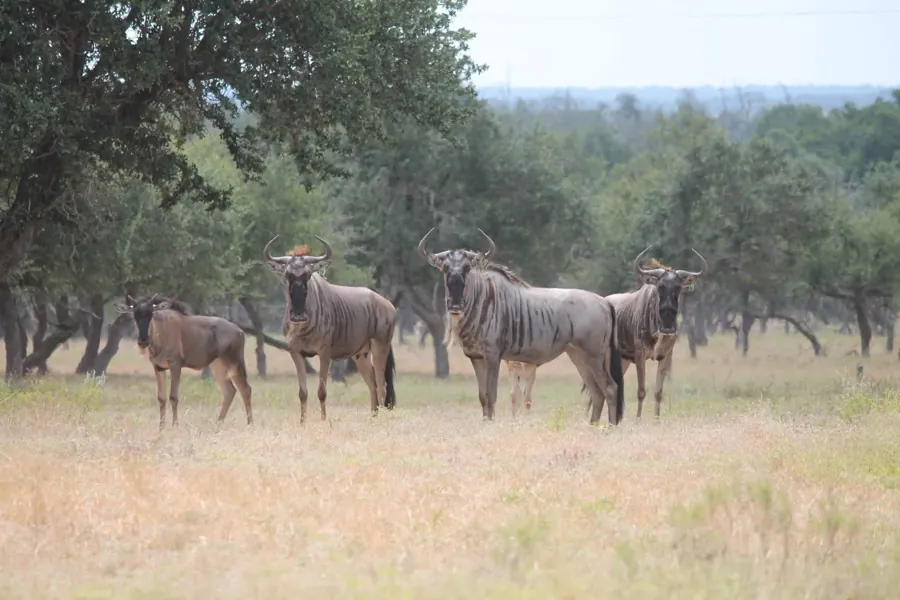
Photo: Bernard DUPONT from FRANCE / Wikimedia Commons, CC BY-SA 2.0
Black Wildebeest Hunts in Texas
Connochaetes gnouTrophy fee $16,500 · $350 per hunter per day
Hooked horns, a white tail, and a habit of looking back.
- Family
- Plains Game
- Native range
- South Africa, Lesotho & Eswatini
- Weight
- 240–400 lb
- Horns
- Up to 31 in (hooked)
- Trophy fee
- $16,500
- Lodge & guide
- $350 / hunter / day
About the Black Wildebeest
The black wildebeest, also called the white-tailed gnu, is the smaller, darker cousin of the blue wildebeest. Its tail gives it away: long, horse-like and bright white, where the blue's is black. Both sexes carry horns that drop down and forward, then hook sharply up; a bull's are heavier, with a thick, shield-like boss. It also has a brush of stiff black bristles on the muzzle, a black beard and a stiff, upright mane.
It is native to the grasslands and Karoo of South Africa, Lesotho and Eswatini, and it was nearly wiped out. Hunted for its hide and meat and shot as a pest, it was down to a few hundred animals by the end of the 1800s. Free State farmers who protected the last herds on their land helped save it.
Today's herds descend from those survivors, and most black wildebeest now live on private land.
Hunting Black Wildebeest at Black Eagle Ranch
Black wildebeest like open country, and they make a show of leaving it. Pushed, a herd will snort, kick up its heels and run a short way, then stop, wheel around and look back, and do it again if you keep coming. That pause can give you a shot. Hunts are fully guided, on your timeline, across 3,700+ acres of Hill Country, and you pay the trophy fee only for an animal you take.
Like any wildebeest, they are tough for their size, so shot placement and a solid bullet matter. Look for a mature bull with heavy bosses and horns that drop well down before they hook back up. Length counts for more than mass. Black wildebeest are listed with the rest of our African plains game.
Black Wildebeest Hunting FAQ
How do you tell a black wildebeest from a blue wildebeest?
Start with the tail. The black wildebeest's is long and white; the blue's is black. Its horns drop down and forward before hooking up, where a blue's sweep out to the sides first. It is also the smaller and darker of the two.
Was the black wildebeest nearly extinct?
Yes. Hunted for its hide and meat and as a pest, it was down to a few hundred animals by the end of the 1800s. Free State farmers who protected the last herds helped save it, and most black wildebeest now live on private land.
Is a black wildebeest really black?
Mature bulls are a dark brown that reads as black. Cows and young animals are lighter brown, and newborn calves are fawn.
Where can I hunt black wildebeest in Texas?
Black Eagle Ranch in Harper, Texas offers guided black wildebeest hunts in the Texas Hill Country, about 25 minutes from Fredericksburg and under two hours from San Antonio.
How much does a black wildebeest hunt cost?
The trophy fee for black wildebeest at Black Eagle Ranch is $16,500, plus the lodge and guide rate of $350 per hunter per day. The trophy fee is paid only for animals taken, and the balance is due at the completion of your hunt.
How do I book a black wildebeest hunt?
Request your dates on our online reservation calendar and select Black Wildebeest, or call Daniel at (830) 928-3161 or Todd at (409) 300-0575.
More from the Collection.


Reserve your Black Wildebeest.
Trophy fee $16,500, plus $350 per hunter per day.